From wind and solar farms to the Ca Na LNG power project, seaports, and energy industrial infrastructure, Trungnam is pursuing a fundamental question: how far can Vietnamese private enterprises carry out the nation's foundational work.
When the world talks extensively about artificial intelligence, semiconductors, data centers, or space technology, people are often swept up in highly fashionable concepts. But behind all those glamorous races lies a more foundational, quieter, and equally fierce race: the energy race.
Without electricity, there will be no semiconductor factories. Without electricity, data centers are merely cold concrete blocks. Without stable power, high growth ambitions can easily get stuck in beautiful master plans.
For Vietnam, that requirement becomes even clearer as the economy enters a new development cycle. High growth targets are no longer inspirational slogans, but are becoming very real pressure on infrastructure, capital flows, the power grid, and the developmental organization capacity of the entire economy.
In this context, Resolution 68-NQ/TW on private economic development and Resolution 70-NQ/TW on ensuring national energy security have created a new development landscape. One affirms that the private economy is a vital driving force of the economy. The other emphasizes the imperative to build a modern, sustainable energy system, ensuring energy security for the new growth phase.
Those two policy streams converge at one point: Vietnam needs private enterprises large enough, persistent enough, and aspirational enough to venture into difficult sectors that require massive capital and long payback periods, yet hold foundational significance for the nation's future.
Trungnam is a prime testament to that.
The regions of Thuan Nam, Thuan Bac, Phuoc Dinh, and Ca Na years ago were often remembered for harsh sunshine, scorching winds, and extreme aridity. From an agricultural standpoint, this was not a land favored by nature. But as the world shifted toward renewable energy, sunshine and wind turned into strategic resources.
In that race, Trungnam emerged as a private enterprise that knew how to turn construction advantages, execution capabilities, and a "go all the way" mindset into rapid project deployment speed.
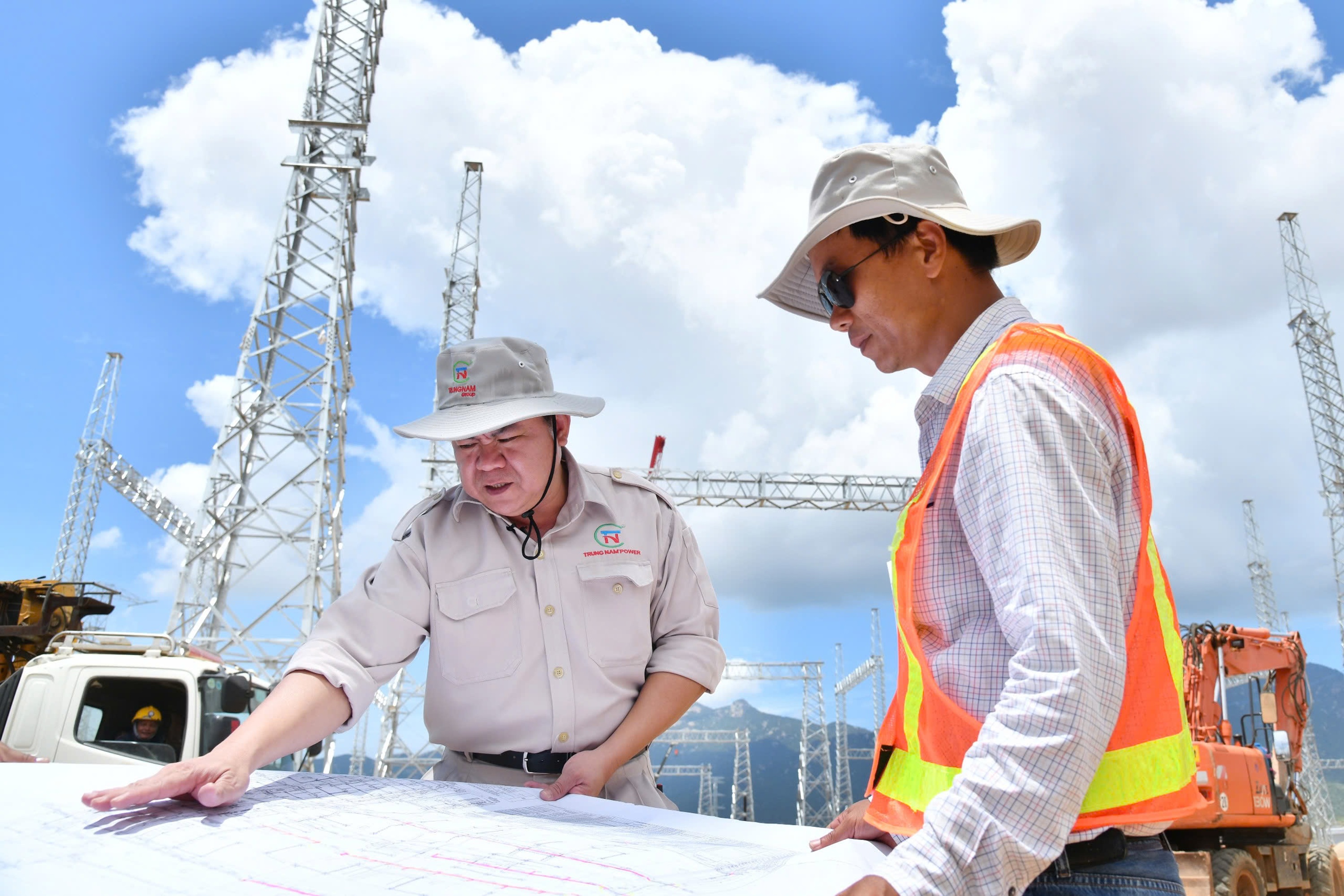
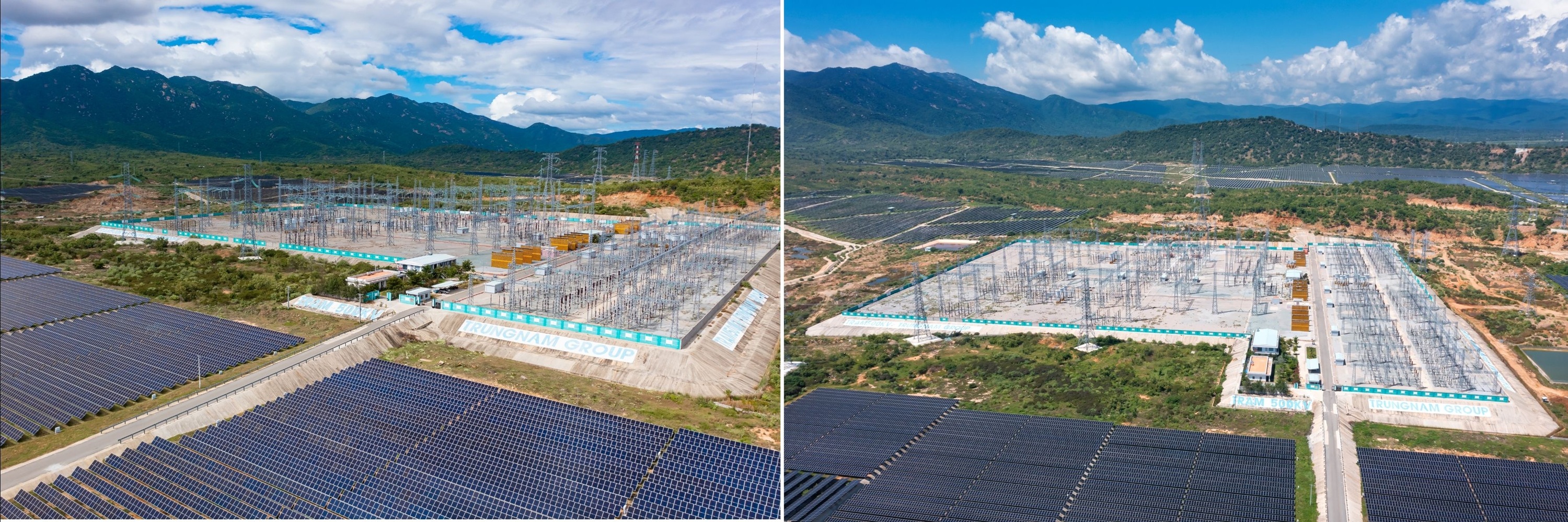
The story of super-fast construction of the 500 kV Substation and 220/500 kV Transmission Line combined with Trung Nam Thuan Nam 450 MW Solar Power Plant in 102 days—with over 8,000 engineers, officers, and workers laboring day and night across hundreds of hectares—remains a memorable milestone in Vietnam's energy sector.
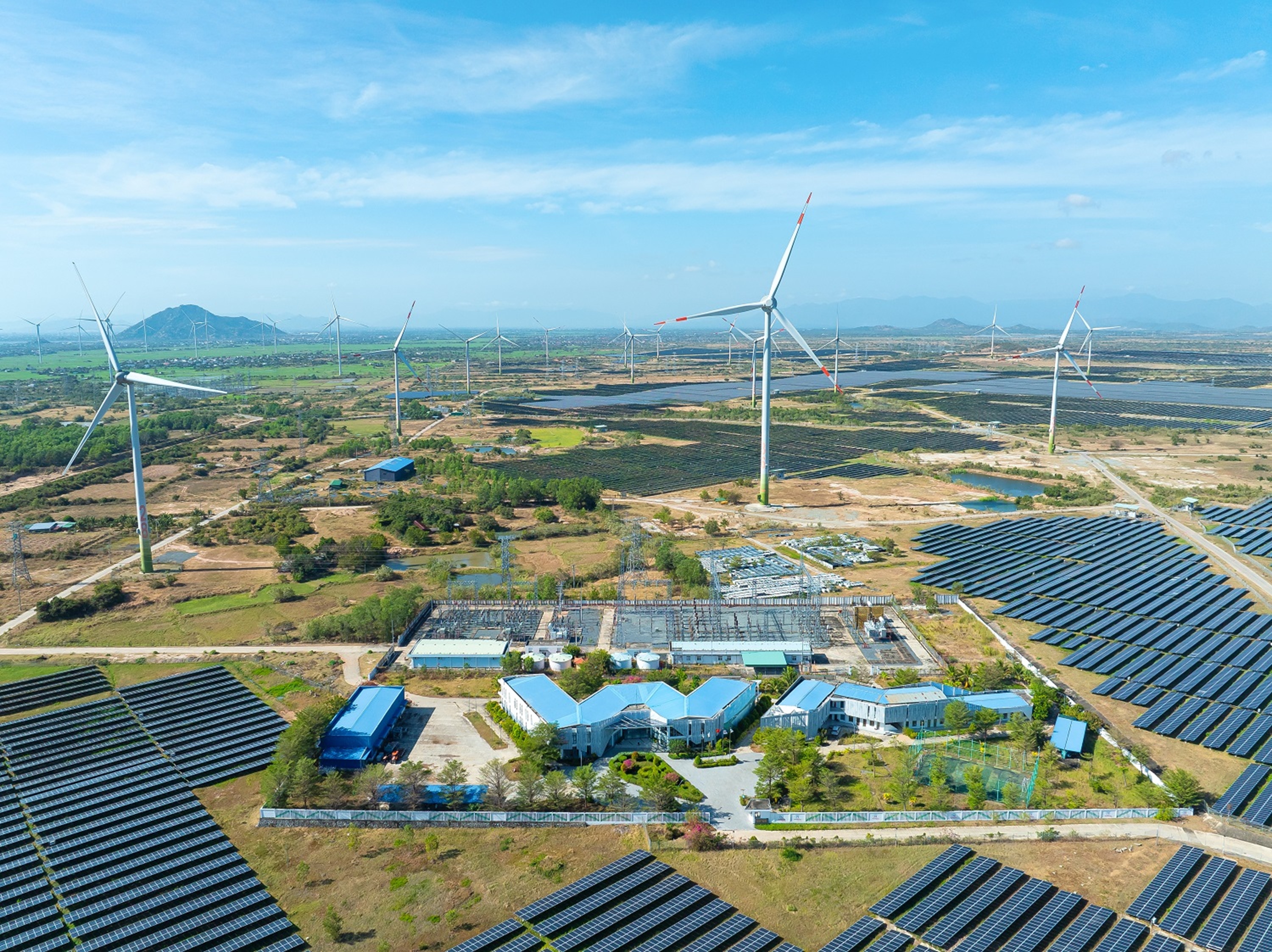
Following that were wind power projects deployed during the intense COVID-19 pandemic phase, when mobilizing personnel, transporting equipment, and renting super-heavy transport vehicles were far harder than normal.
Yet turbines were still erected, and wind farms were completed right on schedule. This served as clear proof that Vietnamese private enterprises not only seize opportunities, but can also endure immense pressure when entering complex infrastructure projects.
 |
|
Mr. Nguyen Tam Tien at the construction site of Trung Nam Thuan Nam Solar Power Plant Project combined with Thuan Nam 33/220/500kV Substation and Transmission Line.
|
What is notable about Trungnam is not just the number of projects or the scale of investment capital. More importantly, it is how this enterprise approaches the energy sector as an entire ecosystem, rather than a hunt for individual projects.
They build solar and wind power facilities and transmission lines. They develop power sources, but also recognize grid bottlenecks early on. They do not merely ask "how many MWs can be produced," but also ask where that power goes, how it connects, and what national growth capability it serves.
That is a crucial shift. Because in energy, an isolated power plant can generate output. But a new energy ecosystem creates developmental capacity.
Looking at Trungnam solely through solar and wind farms is still insufficient. Renewable energy is an essential starting point, but cannot be the complete answer for a modern power system. The sun does not always shine. The wind does not always blow. Meanwhile, an economy's demand for electricity knows no rest.
Therefore, a sustainable energy system requires balance among power sources, transmission infrastructure, seaports, logistics, industrial parks, and foundational projects large enough to guarantee long-term energy security.
That is why the Ca Na LNG Power Project became a cornerstone piece in Trungnam's strategy.
With a capacity of 1,500 MW, total investment exceeding VND 57,000 billion, expected to supply approximately 9 billion kWh of electricity annually, alongside an LNG port terminal system with 1-1.2 million tons/year capacity, storage tanks, regasification units, LNG import berths, a 2,400-meter breakwater, and synchronized technical infrastructure, the Ca Na LNG Project is not merely a power plant but carries the structure of a complete energy infrastructure complex.
And viewed more broadly, it is a move aimed at transforming Ca Na from an arid land into an energy industrial growth pole for the South Central Coast.
Interestingly, Ca Na almost fully gathers the conditions an energy hub requires: abundant sunshine for solar power, strong winds for wind power, a coastal location to receive imported LNG, and geological foundations with space to develop seaports, logistics, and industrial parks. Most importantly, a domestic enterprise has spent years preparing the infrastructure.
Although Ca Na Industrial Park developed by Trungnam received investment policy approval alongside Phase 1 investor approval in June 2025, the concept of an energy center here was discussed long ago, when Trungnam first entered the region for renewables back in 2018.
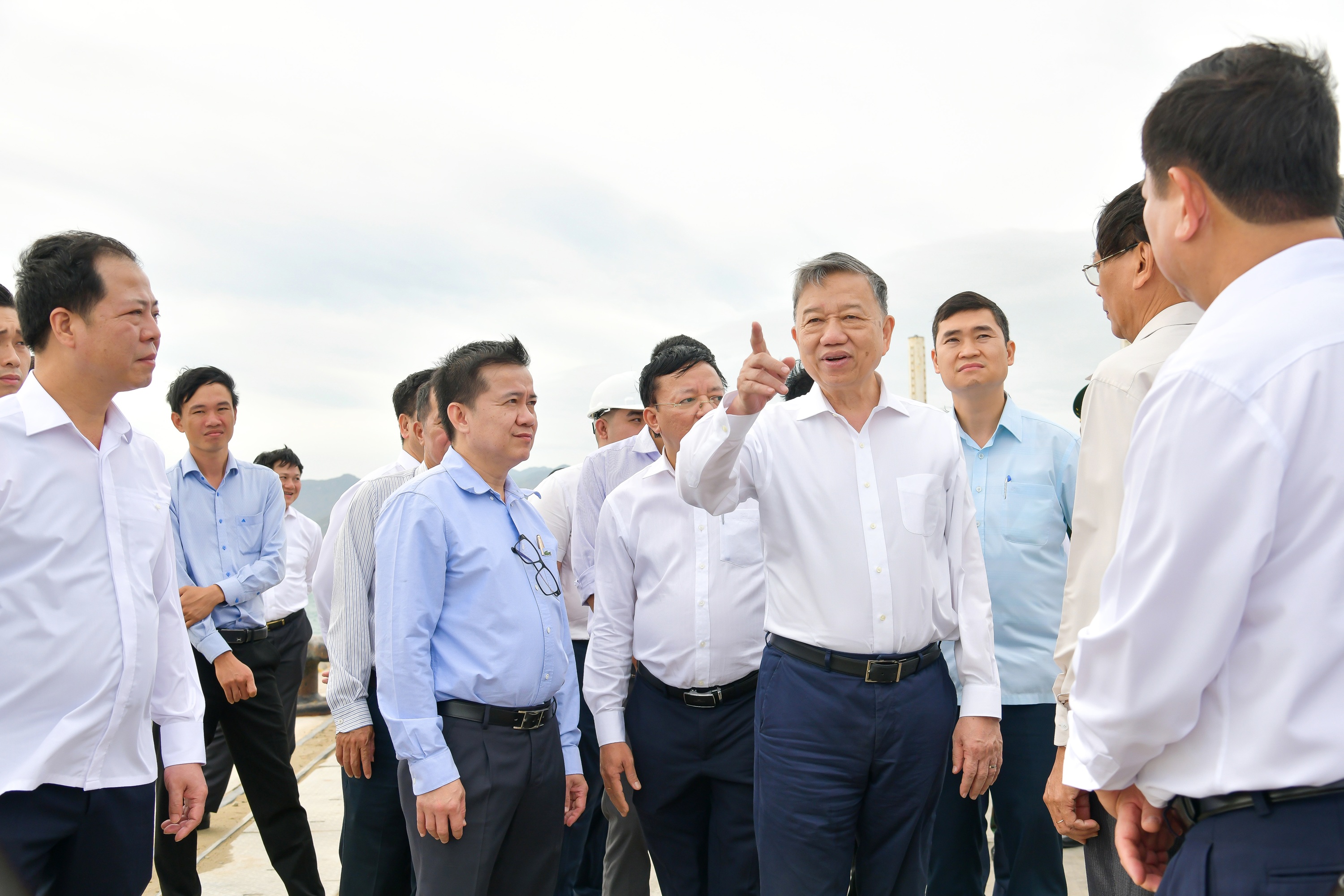
Currently, Trung Nam Ca Na International Port with total investment of VND 5,600 billion is deploying Phase 2 with Berth 1B, aiming to receive general cargo, containers, and large-tonnage bulk cargo, including super-heavy structural components for energy projects.
As of April 2026, over 3.4 million tons of cargo have been cleared through the port. Vessels docking at Ca Na Port bring not only cement, granite, construction materials, or industrial goods, but also carry a clear message: infrastructure must lead the way for industry to follow.
 |
|
General Secretary To Lam visiting Trung Nam Ca Na International Port on December 5, 2024.
|
This highlights the difference in how Trungnam views the Ca Na LNG project. Where many investors might approach from the perspective of building a single power plant, Trungnam approaches from the perspective of an energy hub—a place where power plants, seaports, LNG storage, industrial parks, logistics, and new energy projects seamlessly connect.
In April 2026, the Trungnam - Sideros River consortium signed the investment contract for the Ca Na LNG Thermal Power Plant Project with the Khanh Hoa Provincial People's Committee, marking a major milestone after years of preparation. The target is completion and commercial commissioning before the end of 2030.
If completed on schedule, Ca Na will not only add a massive power source to the national grid but also unlock a new value chain: from LNG importation, regasification, power generation, energy logistics, industrial services, to the capacity to accommodate offshore wind projects, hydrogen, data centers, or future industries requiring stable power supply.
It is not just adding another project to an investment portfolio. It is building an infrastructure foundation large enough for future industries to anchor upon.
That is likely what Trungnam pursues behind the Ca Na LNG Power Project and ongoing infrastructure works. And Ca Na—a land once remembered for sun, wind, and scarce rain—will take on a new appearance as the LNG gateway of Central Vietnam, an energy foundation for green industry, and a key link in ensuring national energy security.
Viewed from the outside, Trungnam's journey can be told through numbers: tens of trillions of VND invested in renewable energy with 1.63 GW of wind and solar capacity, the first private 500 kV transmission line, deep-water seaports, and the VND 57,000+ billion LNG power project…
But behind those figures lies a far less romantic reality, because energy is not a field for those seeking quick wins.
An energy project has a lifecycle spanning decades. Capital investments are massive. Technology is complex. A shift in planning forces enterprises to recalculate. A policy delay of one step can freeze cash flows for years. Global energy market fluctuations require financial spreadsheets to be reopened and reworked.
In such sectors, enterprises need not only money, but also the capacity for endurance.
Mr. Nguyen Tam Tien, CEO of Trungnam, once spoke of the feeling of "running while finding the path" for private enterprises in the energy sector. That phrase sounds gentle, but is profoundly real. Because at many points, investors are not only deploying projects but also learning to navigate policy corridors that are not yet fully stabilized.
He also shared that what enterprises need is not special favors, but a transparent mechanism so investors do not have to live with constant anxiety.
In the energy sector, transparency is not a difficult request—it is a condition for survival. Because if legal bottlenecks persist, price mechanisms remain unclear, power purchase agreements (PPAs) are not secure enough for banks to disburse funds, or capacity clearing falls behind factory investment schedules, enterprises can pay a price of thousands of billion VND.
Trungnam is also undergoing such shocks. There are renewable energy projects where turbines keep spinning and solar power feeds into the national grid, yet the cash flows returned to the enterprise remain incomplete relative to expectations.
 |
|
Trung Nam Wind Power
|
For an enterprise, that is not merely financial hardship. It is a test of endurance, governance, and faith.
That shock forced Trungnam to examine itself deeply. The enterprise entered a restructuring process to become leaner, tighter, more cautious, and more resilient.
Mr. Tien used the word "comeback" frequently when speaking of Trungnam's new phase. A word that sounds closer to football than the power sector, yet fits remarkably well.
"Comeback" does not mean returning with noisy announcements. Instead, it means paying off old lessons, reinforcing internal strength, rearranging capital sources, revamping governance, and continuing into tougher projects.
What is notable is that after those difficulties, Trungnam did not abandon energy. The enterprise chose to push forward with LNG, seaports, industrial parks, energy logistics, offshore wind, and infrastructure components for the future.
That choice is hard to understand through short-term profit logic alone. In the market, there are always sectors with faster capital turnover, less policy risk, and easier profit generation. But Trungnam selected sectors requiring massive capital, long horizons, and multi-layered pressure.
Perhaps because they see something larger than single-project profits.
 |
|
Trung Nam Solar Power
|
In an economy striving for rapid growth, electricity and energy security cannot be side notes. They are the backbone. A nation aiming to attract semiconductors, data centers, high-tech manufacturing, or new supply chains cannot rely solely on tax incentives, land, or labor. Major investors care deeply about: whether electricity is sufficient, stable, supplied long-term, and backed by matching logistics infrastructure.
And thus, energy development is no longer just a power sector story—it is a matter of national competitiveness.
This is precisely the spirit conveyed by both Resolution 68 and Resolution 70 in different ways. Private enterprise is expected to become the most important driver of growth. Energy is identified as the strategic foundation for fast, sustainable, and autonomous development.
When those two spirits meet, the role of private enterprises like Trungnam becomes clearer. They are not merely investors seeking projects. They are forces capable of solving major national problems across infrastructure, energy, logistics, and green industry.
Naturally, to achieve this, private enterprises cannot rely on aspirations alone. Aspirations without governance, finance, technology, and execution discipline easily turn into slogans. Conversely, with pure financial calculation lacking aspiration, few enterprises would dare enter sectors where payback periods exceed a corporate leadership cycle.
Trungnam stands between those two imperatives: dreaming big enough, yet governing tightly enough.
This is the true test for the new generation of Vietnamese private enterprises.
The development history of many nations shows that major leaps forward require corporate entities large enough to walk alongside the nation.
Post-war Japan had industrial conglomerates laying foundations for modernization. South Korea had chaebols acting as locomotives to bring the economy global. All newly industrialized nations possessed domestic enterprises capable of accumulating technology, capital, governance, and large-scale production organization.
Vietnam today faces a similar requirement.
To step into the high-income country group, Vietnam cannot rely solely on processing, consumption, or cheap labor advantages. The economy must possess domestic enterprises large enough in foundational sectors: energy, infrastructure, logistics, industrial manufacturing, technology, and high-value services.
That is why Trungnam's story is not just one group's narrative.
It reflects the aspiration of a layer of Vietnamese private enterprises seeking to grow with the country, rather than merely growing off short-term opportunities.
The most significant point is not how many additional MWs of power or hectares of infrastructure Trungnam builds. The larger expectation is that the capacity of Vietnamese enterprises to organize large industrial ecosystems is elevated to a new level. Trungnam's CEO candidly shared: when domestic businesses grow wealthy, capital stays in this country.
That statement is unpretentious, but touches a fundamental aspect of development. If major infrastructure projects are viewed merely as profit opportunities, the perspective is narrow. But if viewed as a national capacity accumulation process, the story is entirely different.
When a Vietnamese enterprise can build seaports, power plants, logistics infrastructure, arrange international capital, partner in technology, and operate billion-dollar projects, that capacity resides not only on corporate balance sheets. It becomes an integral capacity of the economy. That is precisely what Vietnam desperately needs in the upcoming era.
Naturally, this road will not be smooth. LNG is impacted by global gas markets and geopolitics. Offshore wind faces policy, survey, grid connection, and marine spatial planning challenges. Hydrogen remains a long-term journey. Data centers require clean, stable power and robust digital infrastructure. Even a seaport requires synchronized hinterland industrial development to reach full capacity.
Yet if we refrain from doing it because it is difficult, Vietnam will continue to stand outside new value chains.
The difficulty facing Vietnamese private enterprises today is not merely a lack of capital. Often, the greater hurdle is proving that one possesses sufficient capability to be trusted with major tasks. And once entrusted, proving again that one has the grit to see it through to the end.
Trungnam learned expensive lessons in renewable energy. But those very lessons can serve as assets for the new phase. An enterprise that has never weathered storms can easily speak eloquently about aspirations. An enterprise that has paid a real price in cash flows, debt pressures, and years of restructuring—and still chooses to return to energy—holds aspirations with far greater weight.
At Ca Na, behind those mega construction sites lies not just one firm's ambition, but the image of Vietnam's private sector stepping into a much "larger game."
That game demands capital, clear policy, transparent governance, financial discipline, technology, international partners, and the psychological endurance of those who dare walk long distances.
Yet a nation striving for high growth, greater self-reliance, and a higher position in global value chains cannot lack enterprises bold enough to enter that game.
Trungnam is striving to translate those two policy spirits into concrete projects at Ca Na: power plants, seaports, industrial parks, logistics, and a new energy hub.
Many bottlenecks remain to be resolved. The journey from blueprints to commercial operations will involve rounds of negotiations, capital arrangements, procedural completion, and navigation of market fluctuations. But the fact that a Vietnamese enterprise consistently aspires to develop LNG power, offshore wind, hydrogen, and energy industrial infrastructure—and then expand into data centers and AI—speaks for itself: the industrial dream of the Vietnamese people has never faded.
In the new growth era, Vietnam needs highly realistic dreams built with seaports, transmission lines, power plants, along with real sweat shed on scorching construction sites and financial models keeping insiders awake at night. With genuine works built by enterprises bold enough to go far in difficult sectors, the nation's standing will grow increasingly affirmed.
Source: Bao Dau Tu (Investment Newspaper)