For a long time, private enterprises primarily existed at a small scale, focusing on commerce, civil construction, or subcontracting. Major infrastructure-logistics works, energy projects, or power transmission systems remained almost exclusively the domain of state-owned enterprises and foreign corporations.
However, after decades of accumulating capability, a new class of Vietnamese private enterprises is no longer participating merely as sub-contractors or processors, but has stepped deeper into these core sectors. Along with opportunities come challenges regarding cash flow, corporate governance, technology, and institutions—hurdles that Vietnam's private sector previously never faced at such a massive scale.
Trungnam's story partly reflects that journey. From an infrastructure construction enterprise, Trungnam has now expanded into renewable energy, power transmission, LNG, and deep-water seaports, building a synchronized infrastructure-energy ecosystem aligned with national infrastructure master plans and establishing regional-scale energy hubs. Even more notable is how they navigated periods of rapid growth, weathered major market shocks, and self-adjusted to define a long-term path.
Looking back over two decades of development, Mr. Nguyen Tam Tien, CEO of Trungnam Group, shared that the enterprise once went through a phase of explosive growth alongside waves of energy and infrastructure investment. But following major fluctuations, the company was forced to reflect on how to build for the long haul.
"Trungnam was once passionately chasing growth, and we paid a heavy price for that," Mr. Tien candidly acknowledged.
In reality, Trungnam's investment model is capital-intensive, featuring long payback periods and heavy reliance on operational cash flows from energy and infrastructure assets. When market conditions are favorable, growth can be swift. But the moment mechanisms shift or cash flows get interrupted, financial pressures emerge immediately.
Those very impacts taught Trungnam invaluable risk management lessons when operating in sectors with extended investment cycles: expansion cannot occur at all costs, but capability must be built sustainably.
On the other hand, post-restructuring, what stands out is that Trungnam did not shrink or retreat from challenging sectors. On the contrary, the enterprise continues expanding into larger-scale energy and infrastructure projects, adopting a far more cautious and long-term approach: prioritizing long-distance endurance—from cash flow management and risk control to selecting appropriate investment timing and scale.
Currently, Trungnam is pursuing an integrated ecosystem model where LNG, seaports, industrial parks, renewable energy, and logistics are aligned within a single development structure. The industrial–energy–logistics complex under deployment at Ca Na serves as the clearest illustration of that direction.
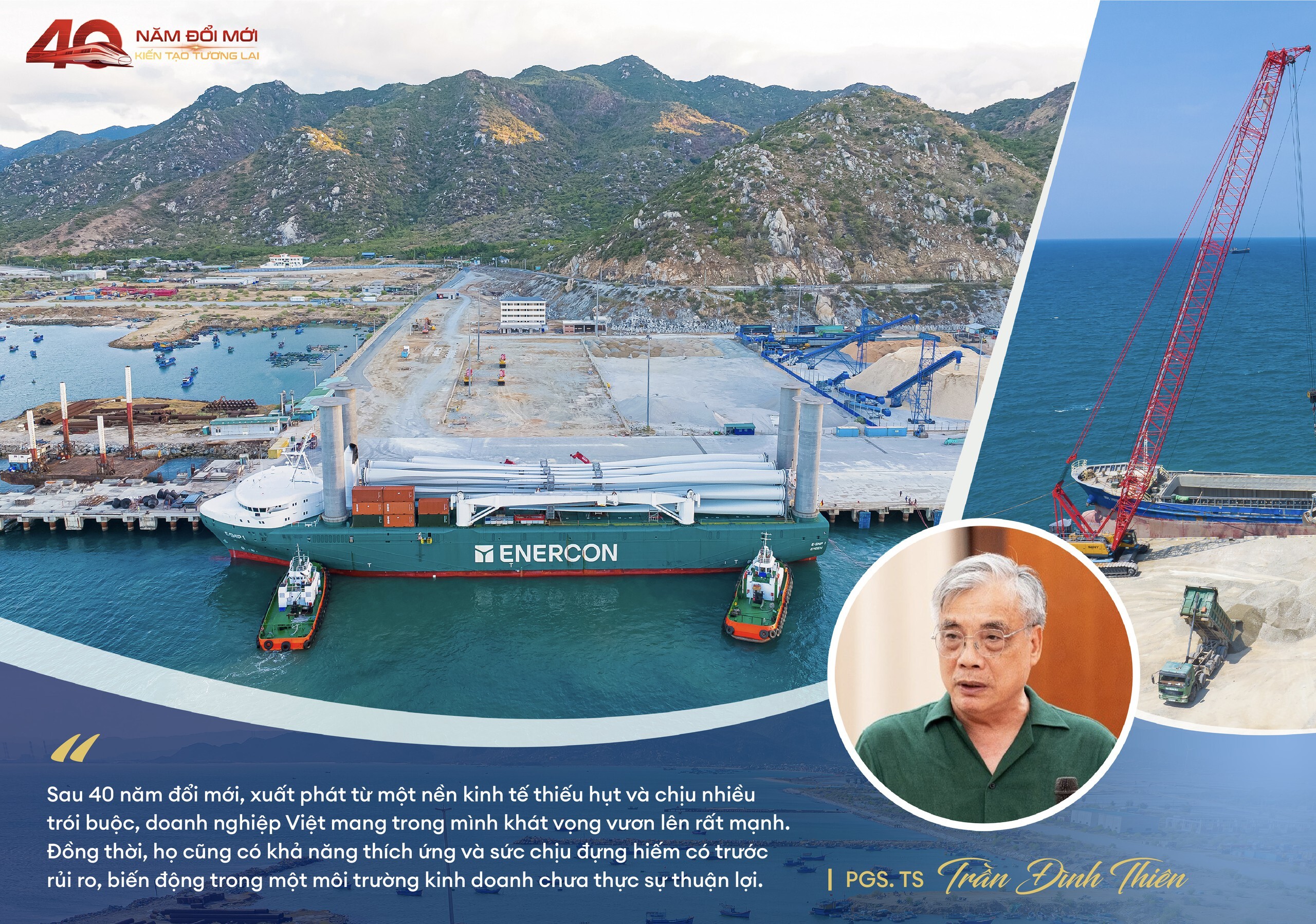
In late 2025, Trungnam won the bidding for the Ca Na LNG project, received the investment registration certificate for Ca Na Industrial Park, and finalized financing negotiations for Ca Na General Seaport Phase 1B. The three pillars—LNG, industrial park, and seaport—are progressively forming a foundational framework for developing a regional energy hub in the South Central Coast.
Among them, Ca Na General Port 1A continues as an open gateway connecting southern Khanh Hoa with international shipping routes, while Port 1B is oriented to handle super-heavy, super-length cargo for the energy industry upon completion in mid-2027. Meanwhile, Ca Na Industrial Park is completing final site clearance steps to prepare for construction, attracting interest from Japanese and Chinese partners exploring factory development. For the LNG project, Trungnam is finalizing legal procedures for official ground-breaking.
Beyond LNG and seaports, the group is pursuing development plans for pumped-storage hydropower, solar power, renewables, and downstream manufacturing industries tied to energy. At Ca Na, Trungnam is answering a vital question: can a Vietnamese enterprise successfully organize a regional-scale industrial–energy–logistics complex?
Years ago, Vietnamese private firms were tied to sectors with short capital turnover and quick payback. Today, enterprises like Trungnam are stepping deeper into energy infrastructure, seaports, and logistics, shifting toward foundational fields requiring long-term vision for the national economy.
"After 40 years of Doi Moi, emerging from a deficient economy bound by constraints, Vietnamese enterprises carry an immense aspiration to rise up. Concurrently, they possess rare adaptability and resilience against risks and market volatility," assessed Assoc. Prof. Dr. Tran Dinh Thien.
 |
Lessons from Trungnam show that for a private firm to pursue large-scale infrastructure projects over extended periods, the key lies not only in capital or technology, but in corporate culture, resource organization, personnel alignment, and execution drive. From years of field experience, Mr. Nguyen Tam Tien shared that Trungnam established its own core philosophy: "The 5 Ks."
The first factor is Khát vọng (Aspiration)—the drive to conquer major projects. In infrastructure, the core force comprises engineers and workers laboring under high intensity on site day and night. To maintain their morale, leadership must foster a sense of shared commitment to large goals. The second K is Kỷ luật (Discipline). Without strict discipline and clear targets, maintaining construction progress is nearly impossible.
The third K is Kỹ thuật (Technique). Enterprises must continuously learn and avoid complacency. Trungnam does not claim breakthrough inventions, but focuses on mastering technologies, procuring global equipment, and adapting techniques to practical conditions in Vietnam. CEO Nguyen Tam Tien calls these "resource-optimized solutions"—flexible approaches maximizing available assets.
The fourth K is Kiên trì (Perseverance). Once targets and schedules are set, the enterprise must follow through to the end regardless of weather or execution pressures. Finally, Kiên định (Steadfastness) ensures the organization holds firm to its chosen long-term orientation.
Discussing the path to walk alongside national growth, Mr. Nguyen Tam Tien noted that compared to regional or international peers, Vietnamese firms remain relatively small in financial scale, cash flow, and ability to create instant tech breakthroughs. Therefore, rather than competing head-on in sectors requiring massive cash burn over decades to build global brands, Trungnam focuses on areas directly tied to Vietnam's advantages and growth demands—specifically energy and infrastructure.
According to Mr. Tien, technology in modern sectors like energy is globalized. Foreign corporations purchase technology from GE, Siemens, Mitsubishi, or Ansaldo; Vietnamese firms can access the exact same tech. What creates the difference is the capacity to organize execution, construct, operate, and adapt to domestic market realities.
"Foreign entities buy technology, we also buy technology. What matters is whether we can organize execution," he emphasized.
A similar story unfolded in infrastructure. Two decades ago, domestic contractors could hardly master complex projects like cable-stayed bridges. But through "learning by doing," starting from sub-contractor roles, domestic firms accumulated technical competence and execution experience. Today, across expressway and mega-bridge projects, the role of local contractors has evolved dramatically.
Broadly speaking, Trungnam's journey mirrors how many Vietnamese private enterprises have grown throughout 40 years of Doi Moi: starting not from massive capital or dominant tech, but through learning by doing, accumulating capability across every project, market cycle, and challenge.
Dr. Dau Anh Tuan, Vice Secretary General of VCCI, noted that the most commendable trait of Vietnam's private sector over recent decades is the dedication of self-made entrepreneurs operating within evolving institutional environments and constantly adapting to market shifts. According to him, the private sector is now stepping beyond basic growth participation into leading modernization across new sectors.
Yet as firms move deeper into infrastructure and energy, challenges transcend capital or market opportunities alone.
For private business groups, the greatest risk often stems not from market competition, but from institutional stability. When investing in billion-dollar projects, what firms need most is confidence that legal commitments and investment environments will remain sufficiently stable for long-term calculations. Dr. Dau Anh Tuan defines this as the economy's "invisible capital."
"If the external environment is filled with uncertainty from trade conflicts or geopolitical shifts, the internal environment must serve as a reliable anchor," Dr. Tuan observed.
From an enterprise perspective, Mr. Nguyen Tam Tien emphasized that what private firms need most is a solid foundation to invest with peace of mind. He introduced "The 4 Cs"—core elements for sustainable private sector growth.
The first C is Cơ chế (Mechanism). For multi-decade infrastructure and energy projects, policy stability and predictability are paramount.
The second C is Cơ hội (Opportunity). State authorities, local governments, and enterprises must jointly recognize and leverage growth opportunities organically, aligning mutual interests. When new investment waves emerge, failure to seize opportunities promptly means they quickly move elsewhere.
The third C is Con người (People). In emerging tech and infrastructure sectors like wind power, LNG, or high-tech manufacturing, high-quality human resources are critical. The State needs mechanisms encouraging corporate investment in training, as skilled personnel benefit the broader economy.
The final C is Cộng đồng (Community). Trungnam's leadership cited projects in Ca Na, where local residents strongly support developments seeing job creation and future regional transformation. For major infrastructure, local community backing is essential for long-term execution.
In a broader context, Trungnam's story reflects the maturation of Vietnam's private economic sector after 40 years of Doi Moi. What stands out is not merely the emergence of large firms, but the willingness of private enterprises to step into foundational sectors of the national economy.
To advance further toward Vietnam's goal of becoming a developed nation, the private sector and the State must continue walking side by side, building a resilient economy capable of enduring crisis cycles, self-adjusting after shocks, and continually accumulating capacity for larger nation-building tasks ahead.
Source: CafeF